Endue
Billing Holds That Stop Unready Infusion Claims
3 months
Role
End-to-end Design
User Research
UI Design
Design System
Sprint Planning
Team
Engineering Team
Billing Specialist
Deliverable
Web App Feature
Timeline
3 months
Infusion Billing in a Nutshell
Infusion billing turns each infusion a patient receives into an insurance claim: the drug and its administration (the nurse's time; supplies are usually bundled in). Many infusion centers buy these drugs up front, often thousands of dollars per dose, and are paid back only when the insurer pays the claim. While accurate billing keeps infusion care financially sustainable, the traditional method relies on spreadsheets of payer rules, authorization trackers and clearinghouse portals that are prone to errors and overwhelm small billing teams.
Billing › Setup › Hold rules › AUTH-EXP
Authorization ended or used up Draft
Hold reason AUTH-EXP · Sends held visits to Intake › Prior authorizations
DiscardActivate rule
When a completed visit matches
All of these conditions
Authorization required
is
Yes (payer + drug policy)
Choose a field…
—
—
Then
Test on recent visitsLast 14 days · 312 visits
196 of 312 visits would be held
Visits that need authorization, by plan
What is Endue
Endue delivers an infusion operations platform that helps infusion operators and home infusion pharmacies manage referrals, intake, scheduling, inventory, dispensing and billing in one place, so patients get on therapy faster and teams can focus on care, not clicks. Endue integrates with EMRs such as Epic and NextGen through API or HL7, with pharmacy systems such as CareTend and CPR+, and with claims clearinghouses to ensure accurate data. The company's broader vision is to be one platform for all things infusion, from the first referral to the final payment.
Where we started with infusion billing
Endue released its Billing MVP in 2024, so infusion operators could run their revenue cycle (RCM) in the same platform they use for care: from charge capture and claim creation to submission and payment posting. Our goal as a billing solution is to make preparing and submitting infusion claims simpler and faster.
Billing › Claims
Claims
Northside · December 2024
Export CSVSubmit batch (61)
Created61Submitted1,284Rejected6Denied182Paid1,090
| Claim # | Patient | DOS | Payer | Lines | Charge | Status | ||
|---|---|---|---|---|---|---|---|---|
| CLM-24-1903 | Olivia Bennett | 12/03/24 | UnitedHealthcare | J1745 ×40 96413 96415 | $4,960.00 | Created | Edit · Void | |
| CLM-24-1904 | Marcus Hill | 12/03/24 | Aetna | J2350 ×600 96413 96415 ×2 | $36,354.00 | Created | Edit · Void | |
| CLM-24-1905 | Sofia Ramirez | 12/03/24 | Medicare Part B | J1569 ×80 96365 96366 ×3 | $6,420.00 | Created | Edit · Void | |
| CLM-24-1906 | James Okafor | 12/04/24 | BCBS PPO | J3380 ×300 96413 | $9,880.00 | Created | Edit · Void | |
| CLM-24-1907 | Hannah Park | 12/04/24 | Cigna | Q5104 ×40 96413 96415 ×2 | $4,300.00 | Created | Edit · Void | |
| CLM-24-1908 | Daniel Cho | 12/04/24 | Humana MA | J1756 ×200 96365 | $1,140.00 | Created | Edit · Void | |
| CLM-24-1909 | Ava Thompson | 12/05/24 | Aetna | J2323 ×300 96413 | $11,980.00 | Created | Edit · Void | |
| CLM-24-1910 | Liam Foster | 12/05/24 | UHC Medicare Adv. | J1745 ×40 96413 96415 | $4,960.00 | Created | Edit · Void |
1–8 of 61 · all selected
Endue's billing module had a clean interface and key features like automatic claim creation from completed visits, 837P claim files, multiple locations and tax IDs, clearinghouse submission, payment posting from 835 remittance files, basic billing setup, and role-based permissions. However, the module experienced low adoption: six months after launch, only 12 of the 41 customers who bought the Billing suite were submitting claims through Endue. Most of the others exported claims to fix them in their old clearinghouse portal, and 11 still sent everything to an outside billing company.
Problem space
Current customers and prospects are blocked on adopting Endue Billing.
Opportunities
There is an opportunity to investigate customer adoption issues and identify product enhancements to better serve our target audience: independent infusion centers and home infusion pharmacies whose billing is done by a small in-house team (one to five people) or by an outside billing company working in Endue on their behalf.
How can we enhance Endue Billing to provide a more efficient way of preparing and submitting infusion claims that get paid the first time?
My role
As a Product Designer in a company without a dedicated PM for Billing, I partnered with our engineering lead and our in-house billing specialist, a certified coder with 12 years in infusion billing, to define project scope and objectives. My responsibilities included managing the end-to-end design process, conducting user research and validation with our Operator Advisory Council, documenting requirements, creating high-quality UI designs, contributing to our design system, planning sprints to track progress, and aligning sales, customer success and implementation teams with the product direction. Because our users work with patient data, all research used de-identified data covered by our business associate agreements (BAAs). Every billing rule in this project was reviewed by our billing specialist before it shipped.
Solutions discovery
Based on research, usability testing, self-reported requests and feedback from our sales, customer success and implementation teams, I identified nine potential features to explore. With only seven engineers in the company, and 1–2 engineers per feature pod, we had to stay scrappy and considerate. Our team scored every feature with the RICE model (reach, impact, confidence and effort) so we could compare them objectively and agree on the trade-offs together. These were the priorities for the next two quarters:
- [Billing manager / Automation] Adding Billing Holds will stop visits that aren't ready from being sent as claims, reducing rework and preventable denials, and route each problem to the team that can fix it.
- [Billing manager / Orchestration] Adding a Drug catalog will let teams set how each drug is billed (NDC, HCPCS code, billing unit and administration code class) without depending on the EMR's drug list being clean.
- [Biller / Accuracy, Compliance] Adding Charge checks will compare every claim line with the nurse's infusion record and the drug catalog, and stop lines the documentation doesn't support before they're billed.
- [Scale, Home Infusion Readiness] Adding home infusion claim types (per diem and home nursing for commercial plans, Medicare home infusion therapy services) will let home infusion pharmacies and larger operators bill everything in Endue.
| Candidate feature | Reach customers / qtr | Impact 0.25–3 | Confidence | Effort person-weeks | RICE score |
|---|---|---|---|---|---|
| Billing Holds | 34 | 3 | 90% | 6 | 15.3 |
| Drug catalog | 30 | 2 | 80% | 4 | 12.0 |
| Charge checks | 38 | 2 | 80% | 6 | 10.1 |
| Home infusion claim types | 14 | 3 | 70% | 10 | 2.9 |
| Patient statements | 25 | 1 | 60% | 6 | 2.5 |
| Automatic benefits re-verification | 30 | 2 | 50% | 12 | 2.5 |
| Faster 835 auto-posting | 12 | 1 | 80% | 4 | 2.4 |
| Denials work queue | 20 | 2 | 50% | 10 | 2.0 |
| Payer contract modeling | 10 | 2 | 50% | 10 | 1.0 |
Score = Reach × Impact × Confidence ÷ Effort. Billing Holds doesn't have the widest reach (Charge checks does), but it has the highest impact and the strongest evidence. Home infusion claim types scored close to the next candidates; we chose it because six prospects in the pipeline couldn't buy without it. Pharmacy-benefit (NCPDP) claims were split out to a later release.
Billing Holds project
To show how we delivered projects at Endue, let's take a closer look at the Billing Holds project. It has a clear scope and direction, and it came up in 61 of 214 recorded sales and onboarding calls, more than any other billing topic. In addition to leading the end-to-end design process, I managed the project plan for the whole Billing enhancement effort.
What do our customers hope to accomplish
I wanted a foundation of issues and requirements before designing anything, so I started with what customers had already told us. I searched 214 recorded sales and onboarding calls and 96 billing requests for mentions of holds, authorizations and claims going out too early.
| Customer | Snippets from customer calls: what customers asked for |
|---|---|
| Infusion Center 1 | [RCM director] “So does every completed visit just turn into a claim? Because some of our visits shouldn't be billed the normal way at all, like manufacturer free drug, or our clinical trial patients.” |
| Infusion Center 2 | [Billing lead] “We'd really want one setup for our buy-and-bill drugs and a different one for patients whose drug is white-bagged from the specialty pharmacy. For those we only bill the administration.” [Owner] “And our home infusion side bills per diem, so none of the clinic rules even apply to them.” |
| Infusion Center 3 | [Revenue cycle manager] “…if you're pulling every visit in from CareTend, you're pulling in the ones where the auth ran out last week too. So what are the rules deciding what's actually ready to go out?” |
| Infusion Center 4 | [Billing manager] “Honestly, the root problem is our denials are almost all authorization. Expired auths, or auths that ran out. Like, the auth's good through June 30 for eight infusions, so anything after that date or past the eighth one shouldn't go out. Just being able to catch those before they're sent would be huge.” |
| Infusion Center 5 | [Practice administrator] “Yeah, I'd want a second set of eyes on anything over ten thousand dollars before it leaves.” |
Next, I asked our sales team which customers had paid for Billing and compared that list with product analytics. The gap was clear: 23 of the 41 customers created claims in Endue, then exported them to their old clearinghouse portal to fix them by hand. I also listed 18 prospects in the sales pipeline whose buying decision depended on billing.
I sent a short survey to our Operator Advisory Council, a group of 50+ infusion operators who help shape the product, to learn how they bill today and who would help design the feature. 31 people answered and 16 agreed to work with me. I interviewed all 16: 9 billing managers, 4 home infusion billers and 3 prior authorization coordinators, because authorization problems are fixed by intake, not by billing. I also shadowed two billing teams for half a day each. In both, the billing manager kept a printed list of authorizations close to running out and checked every day's claims against it by hand.
One question came up in every interview with prior authorization coordinators: “Why don't you just stop the infusion from being scheduled?” Endue's intake already checks authorization when an infusion is scheduled. But authorizations change between scheduling and the infusion chair: an auth ends before the visit, the approved visits or drug units run out, or a dose change needs a new approval. Billing Holds is the safety net for what changes after scheduling, and every hold is also a signal to fix intake.
Jobs to be done
[JTBD] As a billing manager, I want to configure which completed visits are ready to be sent as claims so that no effort is wasted in Endue on claims that will be denied or that shouldn't be sent yet: Every completed infusion flows into billing, but not every visit is ready to become a claim. When unready visits show up in the billing queue, billing managers keep side lists of payer rules and expiring authorizations, and have to tell billers which claims not to touch. They also check every batch before it's submitted, to make sure an expired authorization or a missing modifier isn't about to turn a $6,000 drug claim into a denial.
Common hold rules include:
- Authorization (e.g., the visit is after the auth's end date, or the approved visits or drug units are used up).
- Documentation (e.g., the nursing note isn't signed, or the infusion stop time is missing).
- Payer and plan (e.g., a Medicare Advantage plan that just changed its authorization rules).
- Drug (e.g., a new biosimilar whose coverage hasn't been confirmed yet).
- Drug source (e.g., manufacturer free drug or white-bagged drug: bill the administration only).
- Claim amount (e.g., claims over $10,000 need a second review).
- Coverage changes (e.g., the patient's plan changed and benefits weren't re-verified).
- Clinical trial visits (e.g., need trial billing modifiers and the study number).
- Timely filing (e.g., fewer than 30 days left to file).
[JTBD] As a biller, I want to only see visits in my queue that are actually ready to bill, so that I can submit with confidence: On the flip side, it's slow and risky for billers to work around claims they've been told not to send, especially when a held claim can go out by mistake with one click.
[JTBD] As a prior authorization coordinator, I want to see the held visits that need my action, soonest deadline first, so that I can get authorization while it's still possible: Coordinators work authorizations for upcoming infusions all day. A visit that was already given without valid authorization is urgent, because payers grant retro authorization only in narrow cases and only soon after the date of service.
What outcomes are we trying to drive
Expectations
Current customers and prospects are blocked on adopting Endue Billing unless they can stop unready visits from being sent as claims. For people already billing in Endue, we expect Billing Holds to reduce rework and preventable denials, without delaying or hiding money.
Key metrics
I defined metrics before designing so we would know whether Billing Holds worked, and where to look if it didn't. They read as a funnel. If billing managers don't open Hold rules, we have a discoverability problem. If they open it but don't create rules, the rules are confusing or the right ones are missing. If they rely on holding visits one by one, a rule type is missing. If denials don't drop, we're holding the wrong things. And if denials drop but write-offs rise, we're only hiding denials, not preventing them. That last check is why the table has a guardrail row.
| Outcome | How we'll measure it |
|---|---|
| [Adoption] Customers bill in Endue instead of exporting. | [Metric] # of Billing customers submitting claims through Endue |
| [Usage] Hold rules are discovered and used. | [Metric] # of submitting customers who opened Hold rules [Metric] % of submitting customers with at least one active hold rule |
| [Customer] Claims go out ready, without preventable denials. | [Metric] Clean claim rate: claims accepted on first submission with no edits [Metric] Authorization denials per 100 claims, from 835 remittances (CARC 197, 198 and 15) [Qualitative] Which rules customers use and why visits are held |
| [Guardrail] Holds don't delay or hide money. | [Metric] Median days on hold, and held charges by age [Metric] How each hold ends: released and billed, billed for appeal, or written off |
| [Revenue] Billing Holds increases our win rate with prospects evaluating Endue Billing. | [Metric] # of sales calls where holds or authorization checks come up [Metric] Head-to-head win rate on Billing (baseline: 3 of 10 deals in the two quarters before) |
Baseline (Q1, submitting customers): 12 of 41 customers submitting through Endue, 88% clean claim rate, 3.1 authorization denials per 100 claims. Targets one quarter after launch: 60% of submitting customers with an active rule, under 1.5 authorization denials per 100 claims, median hold under 3 days, and fewer authorization write-offs than before holds.
Initial scope and iterations
MVP rules must-haves
- Authorization: This is the most common reason customers hold claims. I suggest we use whether authorization is required (from the payer and drug policy), the authorization's end date, and the visits and drug units it approves, instead of a simple “auth on file” checkbox. It's more precise, and it catches visits after an auth ends or beyond what it approved. Visits and units are tracked separately: an ocrelizumab authorization, for example, approves milligrams of drug (1,200 units of J2350), not a number of visits.
- Payer and plan type: Uses payer data we already receive from intake, so a rule can target “UnitedHealthcare Medicare Advantage” without also holding “UnitedHealthcare commercial.”
- Drug (therapy or HCPCS code): Uses the Drug catalog from priority 2.
- Documentation: Hold a visit until the nursing note is signed and the infusion start and stop times are recorded.
- Every hold needs a reason code, an owner and an ending: Billing teams already sort their work by short hold codes. Each rule sets a reason code, the queue it goes to, and a filing alert (30 days before the payer's limit by default, adjustable per payer contract). Every hold must also end in a recorded outcome: authorization obtained (enter the number and the hold releases itself), billed for denial and appeal, or written off with a manager's approval. Holds release automatically when their condition clears, such as a signed note.
- Charges are posted, only the claim is held: Held visits still post their charges, so held money shows up in unbilled reports instead of disappearing until someone remembers it.
- Individual visit hold or release: Rules never cover every case, so billers need to place any visit on hold with a reason code, or close a hold by hand with an outcome and a note. Ideally they can paste a list of visit IDs to do it in bulk.
- Held visits should be removed from billers' Charge review queue entirely and sent to the team that can fix them, as opposed to staying in the queue but locked.
Test before activating
- To build confidence that a rule holds the right visits, billing managers should be able to test it on recent completed visits before turning it on, and see every visit it would hold and why. Ideally the results can be searched by patient name or visit ID.
What we left out: “Claim amount” was a common request, but it's about who reviews a claim, not whether the claim is ready. It became a review threshold in the Ready to submit step instead of a hold rule. Drug source, coverage changes and clinical trial billing (which needs trial modifiers and the study number, not just a hold) are documented for later.
For nearly every element of Billing Holds, I had our design partners test iterations of wireframes and clickable prototypes. Each session followed a validation study and interview guide based on IDEO's Design Kit. Eight billing managers tested the rule editor, and four prior authorization coordinators tested the holds queue. Participants completed realistic tasks on de-identified sample data, such as “Hold visits whose authorization has ended, then close the hold for V-10244 after the payer approves a retro authorization,” and explained in their own words what they expected the system to do.
Solution discovery: Hold rules live in Billing settings, like most billing systems' rule engines.
Billing › Setup › Hold rules
Hold rules
Rules run on every completed visit.
+ New rule
| Rule | Reason code | Status | Last edited |
|---|---|---|---|
| Auth ended or no units | AUTH-EXP | Active | Jun 2 · Kim B. |
| Nursing note unsigned | DOC-INC | Draft | Jun 2 · Kim B. |
Edit rule: Auth ended or no units
If
Auth required
is
Yes
Auth status
is
EndedNo units
Then
Hold with reason AUTH-EXPCancelSave rule
Billing › Charge review
Charge review
31 visits · 4 locked by hold rules
Mark ready
| Visit · Patient | DOS | Payer | Drug | Status | |
|---|---|---|---|---|---|
| V-10231 Olivia Bennett | 06/03 | UHC | J1745 | Ready to review | |
| V-10244 Marcus Hill | 06/03 | Aetna | J2350 | Locked · AUTH-EXP | |
| V-10252 Sofia Ramirez | 06/03 | Medicare B | J1569 | Ready to review | |
| V-10260 James Okafor | 06/04 | BCBS | J3380 | Ready to review | |
| V-10281 Ava Thompson | 06/05 | Aetna | J2323 | Locked · AUTH-EXP | |
| V-10268 Hannah Park | 06/04 | Cigna | Q5104 | Ready to review | |
| V-10311 Liam Foster | 06/05 | UHC MA | J1745 | Locked · DOC-INC |
What we learnedBilling managers could write rules, but 6 of 8 asked the same question before saving: “How many claims will this stop?” The editor couldn't answer, so they saved, went to Charge review, and counted. Locked rows also stayed in billers' queues. Two billers selected a locked visit and asked why “Mark ready” didn't work, and the prior authorization coordinators in the sessions had no way to see that the locked visits were theirs to fix.
Solution discovery: Billers place holds by hand from the Charge review queue, the way many teams already work.
Billing › Charge review
Charge review
31 visits
Place on hold ▾Mark ready
Payer: Aetna, UHCAuth: Ended ▾Drug ▾Nurse ▾
| Visit · Patient | DOS | Payer | Auth | Drug | |
|---|---|---|---|---|---|
| V-10244 Marcus Hill | 06/03 | Aetna | Ended 05/28 | J2350 | |
| V-10281 Ava Thompson | 06/05 | Aetna | Ended 06/01 | J2323 | |
| V-10330 Chloe Adams | 06/06 | Aetna | Ended 06/01 | Q5104 | |
| V-10188 Ruth Alvarez | 03/20 | Aetna | Ended 03/01 | J1569 |
Billing › Charge review
Charge review
31 visits
Place 4 visits on hold
Reason
Authorization problem ▾
Note (optional)
auth expired, sent to Dana
Assign to
Me ▾
CancelPlace on hold
What we learnedBillers liked this immediately, because it's how their old system worked. But a manual hold is a one-time action: the next day's visits arrived unfiltered, and 5 of 8 forgot to run the filters again. Reasons were typed differently by every person (“auth expired,” “AUTH,” “need auth”), so nobody could report on why claims were held, and holds were assigned to the biller instead of the team that could fix them.
Solution discovery: Billing managers test a rule on recent visits before turning it on, and every rule sends its holds to an owner's queue.
Billing › Setup › Hold rules › New rule
New hold rule
TestActivate
Hold a visit when auth is required and auth status is Ended No units and + add, then send it to Intake with reason AUTH-EXP.
Test on last 14 days: 9 visits would be held · see list
Billing › Setup › Hold rules › New rule
New hold rule
Activate
When a visit matches all of
Auth required
is
Yes
Auth status
is
EndedNo units
Then
Hold · send to Intake · reason AUTH-EXP · alert at 15 days to filingTest: last 14 days
9
visits would be heldV-10244 · Auth ended 05/28
V-10281 · Auth ended 06/01
V-10325 · J2350 units used up
…
V-10281 · Auth ended 06/01
V-10325 · J2350 units used up
…
What we learnedThe sentence version (left) read nicely for one condition and fell apart at three. The structured version (right) let 7 of 8 billing managers finish every task without help. The test panel changed how they worked: they adjusted a rule until the list of held visits matched what they would have held by hand, and then activated it. Choosing an owner and a reason code inside the rule ended the “who fixes this?” question from Direction A.
Applying visual design
Once 7 of the 8 billing managers (88%, above our 80% bar) had completed every rule task without help, and all 4 coordinators could find and close their holds, I moved to visual design. Billing teams spend whole days in these screens, so I designed for density and speed: work queues with counts in the navigation, short reason codes, deadlines in days, and every number lined up for scanning. Below are the final designs for the Hold rules list, the rule editor, and the Billing holds queue.
Billing › Setup › Hold rules
Hold rules
Hold rules run on every completed visit. Charges are still posted, but the claim waits in its owner's queue instead of going to Charge review.
New hold rule
Start from a template
Authorization ended or used up
Most common hold in our research. Sends to Intake › Prior authorizations.
Use template Nursing documentation incomplete
Unsigned note or missing infusion stop time. Sends to Nursing.
Use template Manufacturer free drug
Bill administration only. Sends to Billing.
Coming soonYour hold rules 0 active
No hold rules yet.
Until you add one, every completed visit goes straight to Charge review.
Until you add one, every completed visit goes straight to Charge review.
Built-in claim checks Always on · can't be edited
| Check | Applies to | Type | Caught, last 30 days |
|---|---|---|---|
| NDC and NDC quantity required on drug lines | Medicaid, most commercial payers | Blocks claim | 12 |
| JW or JZ modifier required for single-dose drugs | Medicare Part B | Blocks claim | 9 |
| Authorization number missing on the claim | When authorization is required | Blocks claim | 5 |
| Diagnosis pointer missing on a service line | All payers | Blocks claim | 4 |
| Possible duplicate claim | All payers | Needs review | 2 |
Billing › Setup › Hold rules › AUTH-EXP
Authorization ended or used up Draft
Created from template · last tested 1 min ago
DiscardActivate rule
Reason
When a completed visit matches
All of these conditions
Authorization required
is
Yes (payer + drug policy)
Authorization status
is any of
Ended before date of serviceApproved visits used upApproved drug units used up
Then
Test on recent visitsLast 14 days · 312 visits
9 visits would be held
2.9% of visits · $103,174 in charges · 0 already held by another rule
| Visit | Why it matches |
|---|---|
| V-10244Marcus Hill · Aetna | Auth A-55821 ended 05/28; DOS 06/03 |
| V-10281Ava Thompson · Aetna | Auth A-60117 ended 06/01; DOS 06/05 |
| V-10325Lucas Nguyen · UHC | Auth A-58840: 1,200 of 1,200 J2350 units used |
| V-10330Chloe Adams · Aetna | Auth A-60140 ended 06/01; DOS 06/06 |
See all 9 →
Once active, the rule checks every visit when it's marked complete. It doesn't change claims already submitted. Baseline for comparison: 3.1 authorization denials per 100 claims.
Billing › Billing holds
Billing holds
37 visits · $214,380 in held charges (posted, not billed) · oldest 79 days
Place on holdReassign
All37Intake19Nursing12Billing6
Patient, visit or auth #Reason ▾Payer ▾Sort: days to filing limitOn hold:0–2 d 83–7 d 68+ d 5
| Visit · Patient | DOS | Payer | Drug | Charge | Reason | On hold | To filing ↑ | |
|---|---|---|---|---|---|---|---|---|
| V-10188Ruth Alvarez | 03/20 | Aetna | J1569 | $6,420 | AUTH-EXP | 79 d | 11 d | |
| V-10244Marcus Hill | 06/03 | Aetna | J2350 | $36,354 | AUTH-EXP | 4 d | 86 d | |
| V-10281Ava Thompson | 06/05 | Aetna | J2323 | $11,980 | AUTH-EXP | 2 d | 88 d | |
| V-10325Lucas Nguyen | 06/06 | UHC | J2350 | $36,354 | AUTH-EXP | 1 d | 89 d | |
| V-10330Chloe Adams | 06/06 | Aetna | Q5104 | $4,216 | AUTH-EXP | 1 d | 89 d | |
| V-10342Isaac Moore | 06/06 | Cigna | J3380 | $9,610 | AUTH-EXP | 1 d | 89 d | |
| V-10347Nora Patel | 06/06 | UHC | J1745 | $4,960 | MANUAL | 1 d | 89 d |
1–7 of 19 in Intake · filing limits from each payer contract
V-10244 · Marcus Hill
AUTH-EXP Held by rule
Authorization A-55821 ended 05/28. Date of service 06/03. Ocrelizumab 600 mg (J2350 × 600), Aetna Commercial.
- Owner
- Intake · Tasha Grant
- Held charges
- $36,354.00 (posted)
- Filing limit
- Aetna contract · 90 days · 86 left
History
- 06/03Charges posted; claim held by AUTH-EXP
- 06/04Tasha G. sent a retro authorization request
- 06/06Payer decision pending
Close this hold
Authorization obtained · Auth #
Retro auth denied · bill for denial and appeal
Write off: no authorization manager approval
Close holdOpen authorization
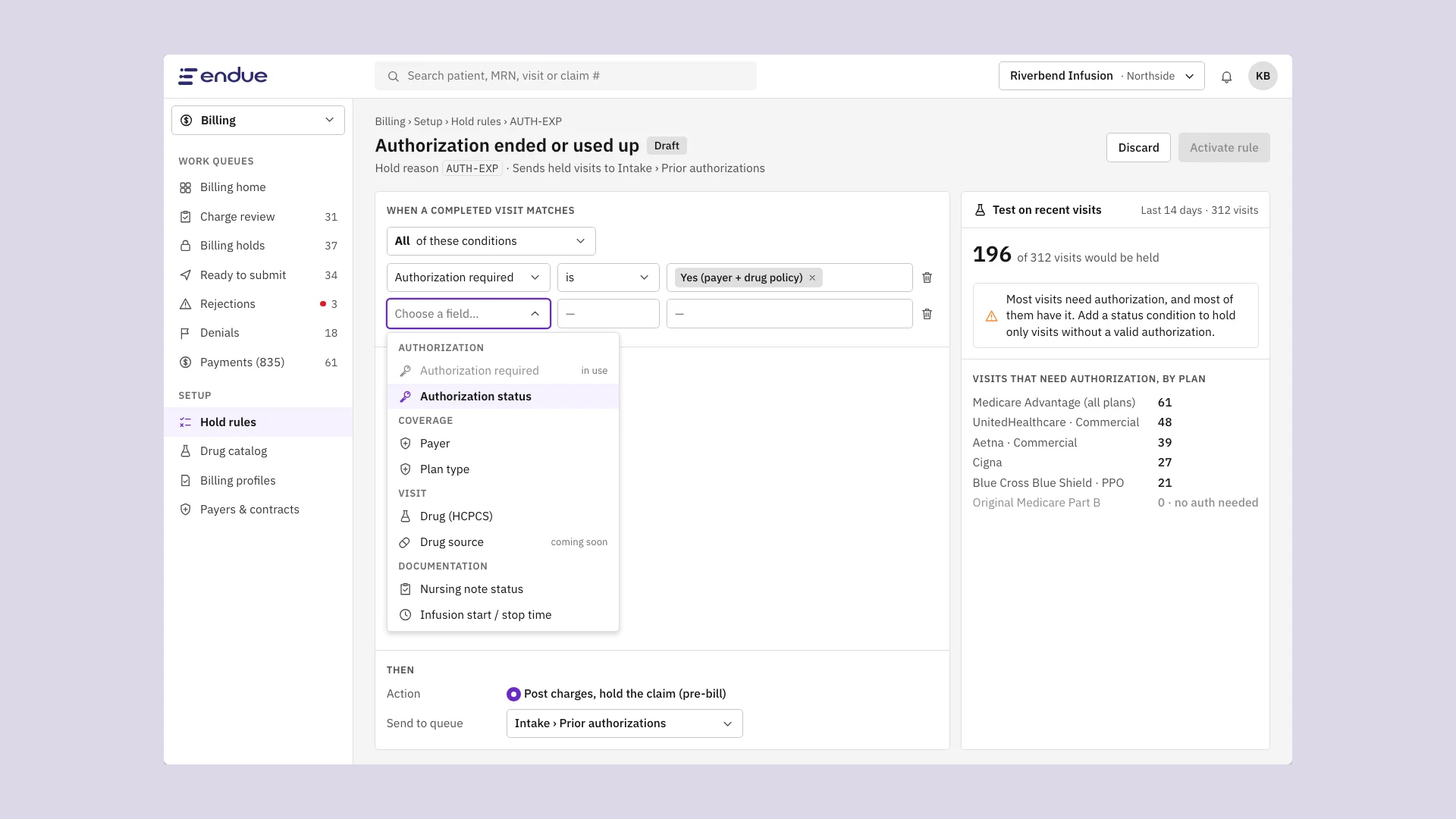
Building and testing a hold rule (interactive replay)
Billing › Setup › Hold rules › AUTH-EXP
Authorization ended or used up Draft
Created from template · last tested 1 min agoconditions changed since last testlast tested just now
DiscardActivate ruleActivate rule
Reason
When a completed visit matches
All of these conditions
Authorization required
is
Yes (payer + drug policy)
Add condition
Choose a field…
Authorization status
—
is any of
—
Choose values…
Ended before date of serviceApproved visits used upApproved drug units used up
Add condition
Then
Test on recent visitsLast 14 days · 312 visits
196 visits would be held
“Authorization required” only
Run test Conditions changed
Checking 312 visits…
9 visits would be held
2.9% of visits · down from 196
| Visit | Why it matches |
|---|---|
| V-10244Aetna | Auth ended 05/28; DOS 06/03 |
| V-10281Aetna | Auth ended 06/01; DOS 06/05 |
| V-10325UHC | 1,200 of 1,200 J2350 units used |
See all 9 →
3 of 6 · Choose values
Final deliverables for full scope of improvements
Additional screens for the other three priorities. The last one, Ready to submit, replaced the MVP's single “Submit batch” button and shipped in the same release; the Billing home dashboard in the Results section came in a follow-up release.
Billing › Setup › Billing profiles
Billing profiles
A profile decides what claims a part of your business creates. Each visit uses the profile of the location and service that delivered it.
New profile
Clinic buy-and-bill
Northside, Eastgate infusion suites · physician office (POS 11)
Claim format837P professional
Drug linesHCPCS J/Q-codes + NDC and quantity
AdministrationCPT 96365–96417 from infusion record
SuppliesIncluded in administration codes
Hold rules2 active
Payers14
Home infusion New
Lakeshore pharmacy · patients at home
Commercial per diemS-codes per day of therapy (e.g., S9338)
Commercial drugHCPCS + NDC, billed separately
Home nursing99601/99602 or per contract
MedicareHome infusion therapy services G0068–G0070, G0088–G0090
Pharmacy benefit (NCPDP)Next release
Hold rules1 active
Where each profile applies Visits, last 30 days
| Location · service | Profile | POS | Claim format | Visits |
|---|---|---|---|---|
| Northside infusion suite | Clinic buy-and-bill | 11 | 837P professional | 670 |
| Eastgate infusion suite | Clinic buy-and-bill | 11 | 837P professional | 418 |
| Lakeshore pharmacy · commercial, at home | Home infusion | 12 | 837P · per diem, drug, nursing | 236 |
| Lakeshore pharmacy · Medicare, at home | Home infusion | 12 | 837P · home infusion G-codes | 41 |
| Northside, Eastgate · white-bagged drug | White-bagged drug Coming soon | 11 | 837P · administration only | 38 |
Billing › Setup › Drug catalog
Drug catalog
64 NDCs mapped · last imported 1 day ago
Import CSVAdd drug
| Drug · package | NDC (11-digit) | HCPCS | Billing unit | Units / package | Administration code | Source |
|---|---|---|---|---|---|---|
| Infliximab-dyyb100 mg vial · new NDC 06/05 | 12345-0102-01 | Not mappedSuggested: Q5103 | — | — | — | Inventory |
| Infliximab100 mg vial | 12345-0100-01 | J1745 | 10 mg | 10 | Complex (96413) | Import |
| Infliximab-abda100 mg vial | 12345-0101-01 | Q5104 | 10 mg | 10 | Complex (96413) | Import |
| Ocrelizumab300 mg / 10 mL | 12345-0150-01 | J2350 | 1 mg | 300 | Complex (96413) | Import |
| Natalizumab300 mg / 15 mL | 12345-0230-01 | J2323 | 1 mg | 300 | Complex (96413) | Import |
| Immune globulin (Gammagard Liquid)10 g / 100 mL | 12345-0500-02 | J1569 | 500 mg | 20 | Therapeutic (96365) | Import |
| Iron sucrose100 mg / 5 mL | 12345-0700-05 | J1756 | 1 mg | 100 | Push 96374 / infusion 96365 | Import |
Administration code class is the default; payer-specific overrides are set in Payers & contracts. IVIG codes are brand-specific, so each brand has its own row.
Billing › Charge review › V-10268
Hannah ParkDOB 04/11/1986 · MRN 448-201
PayerCigna · Commercial
ID U8812345
ID U8812345
AuthorizationA-77310 · visit 3 of 7
ends 03/31/26
ends 03/31/26
Service06/04/25 · POS 11
Dr. Lena Ortiz
Dr. Lena Ortiz
Status1 error
Place on holdMark ready
ChargesInfusion recordDocuments4History
| Ln | CPT / HCPCS | Mod | Units | NDC · qty | Dx | Charge |
|---|---|---|---|---|---|---|
| 1 | Q5104 Infliximab-abda, 10 mg | — | 36 | N4 12345010101 UN3.6 | A | $3,240.00 |
| 2 | Q5104 Drug discarded | JW | 4 | N4 12345010101 UN0.4 | A | $360.00 |
| 3 | J1200 Diphenhydramine, up to 50 mg | — | 1 | N4 12345080001 UN1 | A | $12.00 |
| 4 | 96413 Chemo/complex IV, 1st hr | — | 1 | A | $412.00 | |
| 5 | 96415 Each additional hour | — | 2 | A | $192.00 | |
| 6 | 96375 IV push, sequential | — | 1 | A | $96.00 |
Dx A: K50.90 Crohn's disease, unspecified, without complicationsTotal$4,312.00Expected Cigna payment $3,105.00
From the infusion record signed by J. Lee, RN · 12:31
- 09:40Diphenhydramine 25 mg IV push (premedication)
- 10:02Infliximab-abda 360 mg (5 mg/kg × 72 kg) infusion started
- 10:48Rate increased per protocol
- 12:15Infusion stopped · total 2 h 13 min
- 12:20Waste documented: 40 mg (4 × 100 mg vials opened) · witness M. Ruiz, RN
Charge checks
Error · Line 5
96415 × 2 isn't supported by the infusion record. 2 h 13 min = first hour (96413) + 1 additional hour. The last 13 minutes don't pass the 30-minute mark for another unit. Bill what's documented. If the infusion really ran longer, the nurse must amend the record first.
Bill 1 unitAsk nursing to review record
Calculated · Lines 1–2
Units from the documented dose: 360 mg ÷ 10 mg = 36. 400 mg opened, so 40 mg discarded = 4 units with JW. NDC quantity is split the same way: 3.6 vials given, 0.4 discarded.
Passed
Authorization A-77310 covers this date (visit 3 of 7) and is on the claim · NDC and quantity on every drug line · Diagnosis pointer on every line.
Billing › Ready to submit
Ready to submit
Batch 0606-01 · 34 claims · $198,420 · checked 2 min ago
Re-run checksSubmit 29 claims to ClearPath
29
Passed
Ready to send
Ready to send
3
Needs review
Approve or return to biller
Approve or return to biller
2
Errors
Can't be sent until fixed
Can't be sent until fixed
Needs review3Errors2Passed29Sent batches
| Claim · Patient | Payer | Charge | Why it needs review | Details | |
|---|---|---|---|---|---|
| CLM-25-0431Grace Kim | Medicare B | $36,354 | Over $10,000 review threshold | Ocrelizumab 600 mg · JZ (no waste) | Return Approve |
| CLM-25-0429Isabella Cruz | Aetna | $6,200 | Infusion record amended after charge entry | Dose 500 mg per amended record (J. Lee, RN, 06/06); auth A-61022 updated to 500 mg the same day | Return Approve |
| CLM-25-0440Owen Price | Cigna | $9,610 | First claim for a newly mapped NDC | Vedolizumab · catalog mapped 06/05 | Return Approve |
Last batch · 0605-01 sent yesterday 4:12 pm
| 999 accepted | ClearPath received the file | 33 claims |
| 277CA accepted | Payers accepted the claims for processing | 32 |
| 277CA rejected | Bounced before processing (subscriber ID invalid) · moved to Rejections | 1 |
| 835 received | Payments posted from earlier batches today · 2 denials moved to Denials | 27 paid |
Results and what's next
One quarter after launch, we measured the metrics we defined before designing. All four priorities shipped together, so the adoption and win-rate changes belong to the whole release. The change we attribute to Billing Holds is the drop in authorization denials.
Customers submitting claims in Endue
27 of 41 · was 12
Submitting customers with an active hold rule
22 of 27 · target 60%
Clean claim rate
95% was 88%
Authorization denials per 100 claims
0.9 was 3.1
Usage. 25 of the 27 submitting customers opened Hold rules, and 22 activated at least one rule. Authorization was the most used rule (all 22), followed by Documentation (17).
Guardrail. Median time on hold was 2 days. Of the 1,140 holds closed that quarter, 77% were released and billed after the problem was fixed, 6% were billed to get a denial that could be appealed, and 9% were written off; 8% were still open. Write-offs for missing authorization fell by about a third compared with the quarter before, so the drop in denials came from preventing them, not from hiding them.
Revenue. Holds or authorization checks came up in 4 out of 5 billing demos, and we won 6 of 9 head-to-head deals against an incumbent billing system, compared with 3 of 10 in the two quarters before the release.
The screen below is what one customer's billing manager sees each morning.
Billing › Home
Billing home
Riverbend Infusion · Northside · last 90 days (about 2,000 visits) compared with the 90 days before holds
Last 90 days ▾
Clean claim rate
95%
▲ from 87%
Auth denials per 100 claims
0.8
▼ from 3.0 · CARC 197, 198, 15
Held charges (posted, not billed)
$214K · 37 visits
median 2 days on hold
Holds within 30 days of filing limit
1
V-10188 · 11 days left
Holds by owner and age
Intake19
Nursing12
Billing6
0–2 d3–7 d8+ d
Top denial reasons CARC
| 16 | Lacks information | 31 |
| 50 | Not medically necessary | 19 |
| 96 | Non-covered charge | 12 |
| 197 | Auth absent | 9 |
| 198 | Auth exceeded | 4 |
Auth denials fell from #1 to #4.
Why visits were held
| AUTH-EXP | 86 |
| DOC-INC | 61 |
| MANUAL | 41 |
Most manual holds note “free drug.”
How holds ended
| Released and billed | 123 |
| Billed for appeal | 11 |
| Written off | 17 |
| Still open | 37 |
Auth write-offs: $96K vs $161K before.
Clean claim rate, weekly Before · avg 87%After · avg 95%
Auth denials per 100, weekly Before · avg 3.0After · avg 0.8
That panel confirmed our next priority. Free drug came up in the very first research quote, and the template was already marked “coming soon,” but the number of manual holds moved Drug source from “later” to “next.” Charge checks will use it to bill only the administration when the drug was free or white-bagged.
What I'd do differently: unsigned notes were the second most common hold, as research suggested, but I underestimated how easy they were to prevent. The fix belongs in the nursing workflow (a reminder before a nurse closes the visit), not in billing. I would have shadowed nurses as well as billers, and I would have tested the holds queue with coordinators earlier, before the rule editor was finished.